


Abrasive belt grinding has long been wrapped in a narrative of “universal replacement” in Chinese industry discourse: power utilization is as high as 96%, while milling machines are only 57%; productivity is 10 times higher than milling; powerful abrasive belt grinding of 1-meter-long No. 50 steel bevel saves 34% of time and reduces tool costs by 20% compared with milling. Taken individually, each of these numbers suggests that belt grinding is eating into milling territory.
But put another set of numbers next to it, and the picture changes. A systematic comparison of titanium alloy abrasive belt grinding and milling shows that under optimized dosage conditions, the tool cost of abrasive belt grinding is 2 to 4 times that of milling; under the same efficiency and cooling conditions, both can achieve a surface roughness of Ra<1.6μm, but milling will leave a deteriorated layer of about 50μm, while abrasive belt grinding will have no obvious structural changes. That is, abrasive belt grinding is superior in efficiency and surface integrity, but its advantages are not free – the cost structure of abrasive belts as a consumable is systematically higher than the diluted cost of carbide cutting tools.
Putting these two facts together, the conclusion pointed to is not “abrasive belt grinding is better” or “milling is better”, but a more precise proposition: abrasive belt grinding is redrawing the process boundaries between roughing and finishing, rather than replacing a certain type of machine tool as a whole. Comparative trials in the Dutch sand blaster revealed a key detail: for all tested materials, milling actually had the lowest specific energy consumption, closely followed by belt grinding. If you only look at “machine tool power utilization”, 96% of the abrasive belt grinder does crush 57% of the milling machine; but if you look at “the total energy consumed per unit volume of material removed”, milling still dominates. Power utilization measures the efficiency of a machine tool in converting input electrical energy into cutting energy, while specific energy consumption measures the energy cost of the entire process chain. The former is an equipment indicator and the latter is a process indicator. Taking equipment indicators as evidence of process superiority is a typical indicator substitution.
The real process dividing lines appear on workpiece features. Thin-walled parts, complex curved surfaces, difficult-to-machine materials, and large-margin weld cleaning—the flexible contact and cold cutting characteristics of abrasive belt grinding in these scenarios give it advantages that cannot be reproduced by milling. In the processing of titanium alloy thin-walled parts, the abrasive belt grinding force is much smaller than the milling force at the same material removal rate. This is a structural limitation that rigid tools cannot change. The traditional path for processing the inlet and exhaust edges of blades is wire cutting and trimming followed by manual grinding, which is inefficient and has poor consistency. Robot abrasive belt grinding has moved this link from “handicraft” to “craft”. But conversely, when the workpiece is a regular plane, a large-sized groove, or a cavity that requires strict dimensional tolerances, the rigidity, predictability, and programmability of the tool path of milling are still difficult to cover with abrasive belt grinding.
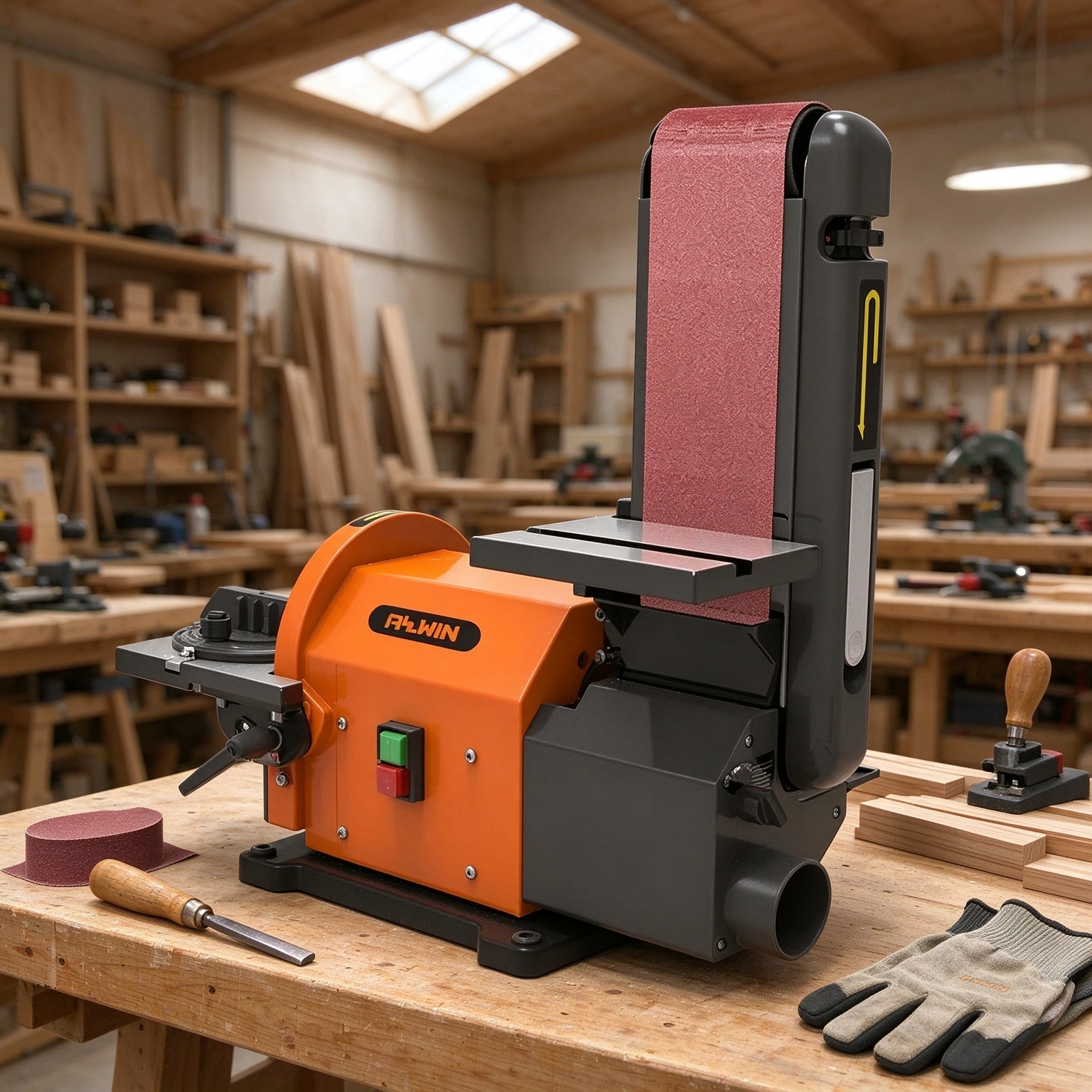
This leads to the most easily overlooked economic implication of “grinding instead of cutting”: the competitiveness of abrasive belt grinding is highly dependent on where in the process chain it is placed. Put it in the roughing section to compete with the material removal rate of large-depth milling, and the cost of abrasive belt consumption will quickly eat up the efficiency advantage; put it in the semi-finishing and finishing sections, use cold cutting and elastic contact to eliminate the deteriorated layer and residual stress left by milling, and its tool cost will be balanced by the surface quality gain. The benchtop belt sander’s position in this framework is particularly delicate: It is cheaper and more flexible than large CNC belt grinders, but more repeatable than hand sanding. Its real value does not lie in “replacing milling machines”, but in incorporating workpieces that could only be manually polished because the batch size was too small, the shape was too complex, and rigid clamping was not cost-effective, into a parameterizable and repeatable grinding process. This is not a grand narrative of “replacing cutting with grinding”, but the quiet penetration of “replacing people with machines” in the grinding process.
Post time: Oct-29-2026