


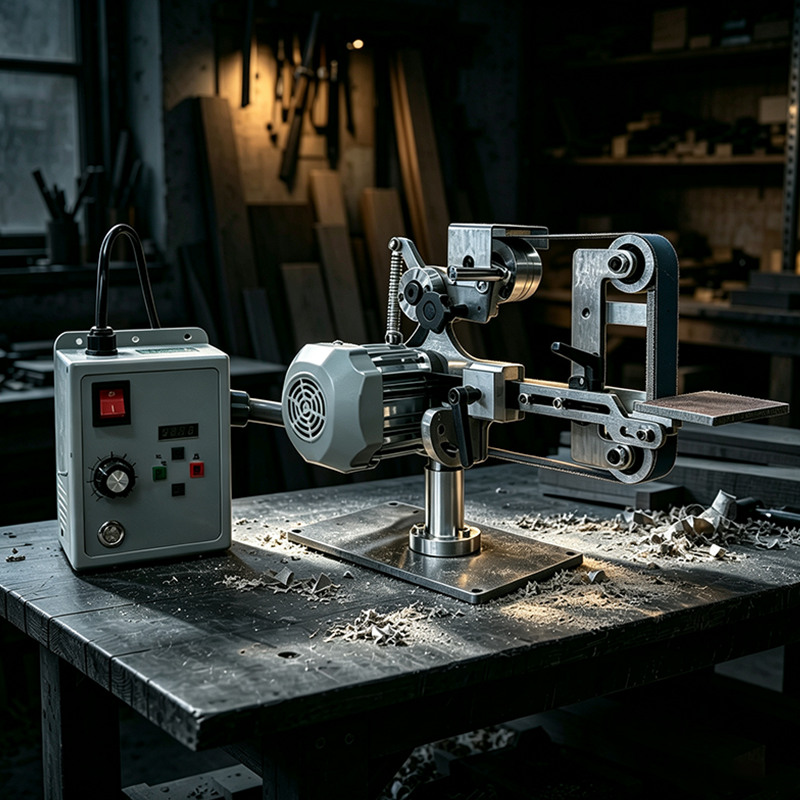
As an indispensable grinding and processing equipment in the industrial manufacturing field, belt sanding machines are used in various scenarios from manual trimming to automated production lines. Depending on the operation mode, power source and grinding form, the belt sanding machine presents a variety of morphological characteristics: for example, the hand-held type facilitates flexible operation, the desktop type is suitable for precision machining, and the vertical type meets heavy-duty grinding; pneumatic and electric drives are suitable for explosion-proof environments and regular production needs respectively. In terms of grinding modes, the contact wheel type is suitable for rough grinding processes, the flat grinding pad type ensures flatness requirements, and the free-suspended type can handle complex curved surface workpieces. Although modern belt sanders have developed advanced forms such as manual control, automated integration and even force-controlled robots, looking at the basic principles of mechanical structure, all belt sander structures revolve around three core elements.
1. Composition and power transmission of drive system
The power core of the belt sander lies in its drive mechanism. This system is responsible for converting the energy output from the power source into the continuous operation of the sand belt. The drive unit usually uses a pneumatic motor or an electric motor as the power source, and selects the corresponding power level and speed characteristics according to different working conditions. The power is transmitted to the sanding belt through the driving wheel (driving wheel). In some designs, idler or guide wheels are also provided to optimize the transmission path. The surface material and geometric parameters of the driving wheel directly affect the friction coefficient and the life of the abrasive belt. Common wrapping materials include rubber, polyurethane or metal tooth surfaces to adapt to specific process requirements such as dry grinding, wet grinding or high-speed grinding.
2. Function realization of tensioning mechanism
Stable and reliable grinding operations must be based on appropriate belt tension. The tensioning mechanism adjusts the relative position between the transmission wheels to achieve a constant and controllable stretching state of the abrasive belt. Modern belt sanding machines generally adopt a two-wheel or multi-wheel layout, and use the displacement of the tensioning wheel to achieve elastic tensioning of the sanding belt. According to the different adjustment methods, it can be subdivided into three types: mechanical jacking, spring preloading and cylinder pressing. Among them, the spring tension relies on the continuous pressure of the elastic element to automatically compensate for the slight elongation of the abrasive belt, with a simple structure and low cost; the cylinder tension can accurately control the tension through air pressure adjustment, which is suitable for automation equipment that requires frequent replacement of the abrasive belt or real-time adjustment of tension parameters. The early single-wheel tensioning method that relied on centrifugal force and size coordination has been gradually eliminated due to insufficient stability.
3. Guidance Principle of Correction System
The axial offset during the operation of the abrasive belt is a key factor affecting the processing quality and the life of the abrasive belt, so the deflection correction mechanism has become an essential component of the belt abrasive machine. The basic principle of the deflection adjustment mechanism is to change the axis angle of a certain transmission wheel so that the abrasive belt is subject to lateral correction force during operation, thereby maintaining its stable running trajectory. Manual correction usually uses an adjusting screw to push the bearing seat, and the operator makes fine adjustments by observing the position of the abrasive belt. In high-end automation models, the system integrates sensors to monitor the edge position of the abrasive belt in real time, and cooperates with the servo motor or proportional valve to drive the correction wheel to automatically correct the offset to achieve closed-loop control. This design not only improves operation continuity, but also provides a technical foundation for unmanned production.
To sum up, the driving mechanism, tensioning mechanism and offset adjustment mechanism constitute the three major technical pillars of the belt sanding machine. The cooperation of the three determines the grinding efficiency, stability and scope of application of the equipment. Belt sanders in different application scenarios are actually differentiated adaptations of structural form, control accuracy and degree of automation based on these three elements.
Post time: Jul-16-2026