


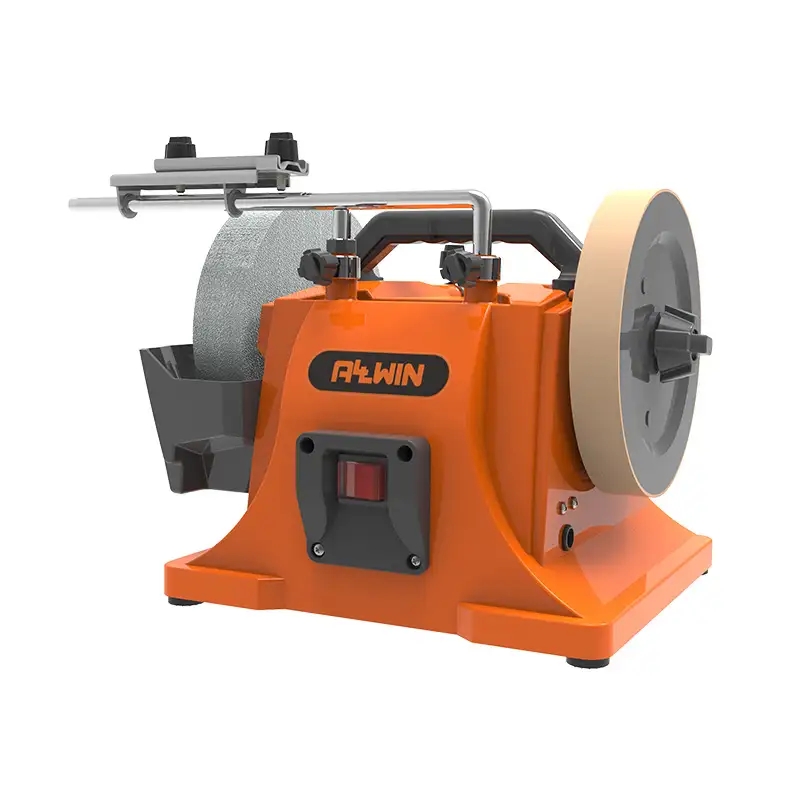
一、Core technical differences between regular models and mini models
1. The conventional knife sharpening machine is designed for high-load, continuous operation scenarios and meets industrial-level processing requirements:
- Power system: The power is generally in the range of 300W to 500W, and the torque output is strong, which can effectively trim large or thick-edged tools such as axes and sickles.
- Grinding mechanism: Standard equipped grinding wheel with a diameter of 150mm to 200mm, high linear speed, single grinding volume increased by about 40% compared to the mini model, significantly shortening the operation time.
- Structural stability: It adopts a cast iron base and an integrated body, which has a large dead weight and can effectively suppress high-frequency vibration and ensure grinding surface accuracy.
- The universal work bracket can be adapted to a variety of grinding fixtures and can meet the needs of various grinding scenarios.
2. The mini knife sharpener is suitable for outdoor, DIY or fine grinding scenarios. Its design emphasizes portability and flexibility:
- Lightweight design: The weight of the entire machine is usually controlled within 3kg, making it easy to carry and move.
- High-speed spindle: The no-load speed can reach 20,000 to 30,000 rpm. With a fine-grained grinding wheel, it is suitable for fine sharpening and polishing of small cutting tools such as engraving knives and fishing hooks.
- Precision guide: Integrated adjustable angle bracket supports stepless adjustment within the range of 15° to 30° to achieve consistency and precise control of the edge angle.
二、Three golden rules for selection decision-making
1. Determine the model according to the operating scenario
- High-load, continuous operations: Such as farms, gardens, metal processing workshops, etc., where large or severely passivated tools need to be frequently repaired, regular models should be given priority to ensure efficiency and equipment life.
- Mobile operations or precision grinding: such as outdoor survival, model making, fishing gear maintenance, etc., which require high portability and angle accuracy, so you should choose the mini model.
2. Consumables compatibility and expandability
- Confirm whether the equipment spindle specifications and clamping system support mainstream abrasives. Diamond grinding wheels are suitable for carbide, while aluminum oxide/silicon carbide grinding wheels are used for common tool steels such as high-speed steel and carbon steel. The compatibility of consumables directly affects the scope of application and long-term use cost of the equipment.
3. Completeness of safety protection design
- Must comply with basic industrial safety standards: equipped with a protective cover to isolate flying sparks and debris; equipped with an emergency brake switch to ensure that the power supply can be cut off instantly in abnormal circumstances; some models should also have a locking function to prevent accidental startup.
三、Professional skills to improve work quality and efficiency
1. Precise temperature control to prevent edge annealing: The high temperature generated by grinding is the main reason for the decrease in edge hardness (annealing). It is recommended to use the “dip cooling method”, that is, immerse the cutting tool in water for full cooling every 30 seconds of continuous grinding to avoid changes in the metallographic structure of the steel.
2. Maintain the grinding wheel profile and self-sharpening: After use, the grinding wheel will lose cutting power due to clogging of metal chips or passivation of abrasive grains. The surface should be trimmed regularly with a diamond dresser to remove blockages and expose fresh and sharp abrasive grains to restore grinding efficiency.
3. Introduce auxiliary tooling to achieve angle quantification: it is difficult to ensure a constant angle with bare hands. Using a special fixture, the sharpening angle error can be controlled within ±1° to ensure the consistency of edge symmetry and sharpness.
4. Optimize the working environment and control operating noise: Structural noise generated by equipment operation can be reduced through physical vibration isolation methods. Industrial rubber shock-absorbing pads are placed between the machine base and the workbench, which can effectively absorb high-frequency vibrations. According to actual measurements, it can reduce environmental noise by about 15 decibels and improve operating comfort.
Post time: Jul-16-2026