


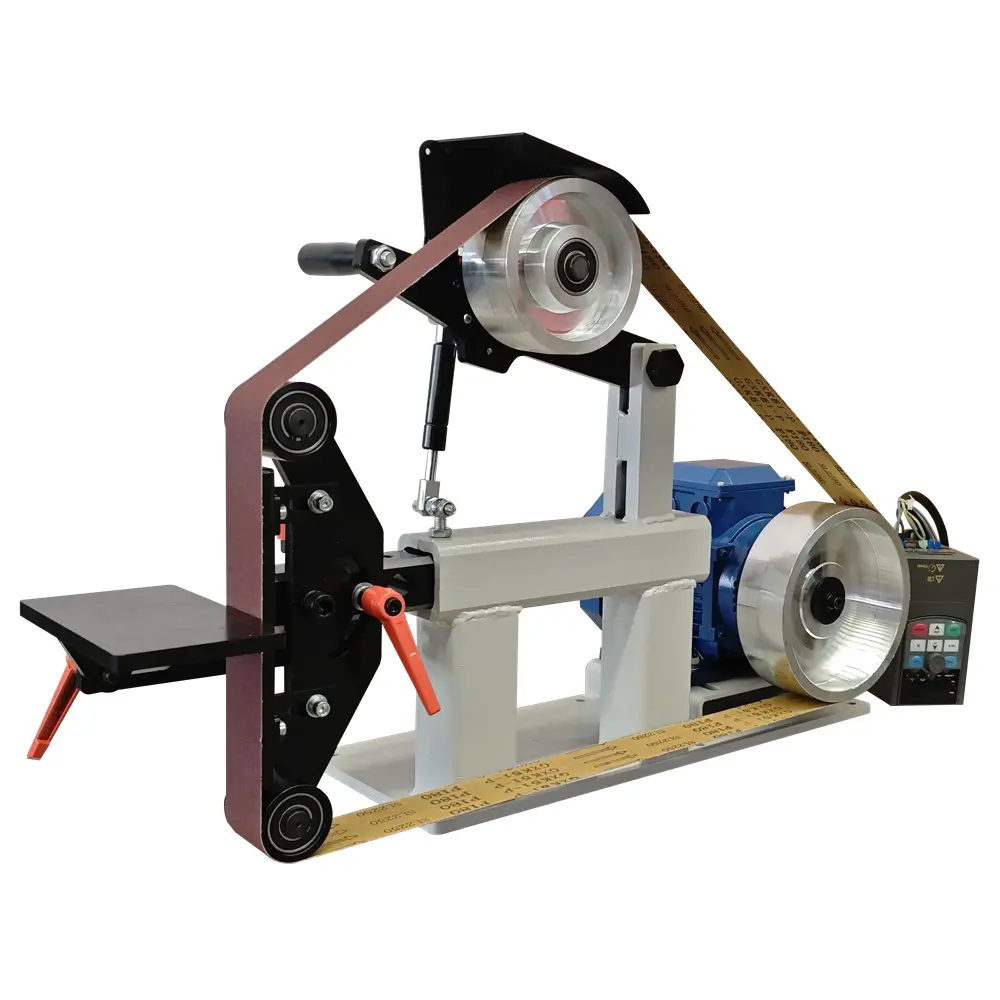
From single-piece and small-batch manual workshops to mass-customized smart factories, sanding machines have become the core process equipment of modern manufacturing due to their efficient material removal capabilities and precise surface finishing effects. It is not only a tool to improve production capacity, but also a key carrier to achieve breakthroughs in product surface quality and promote the evolution of manufacturing processes toward automation and high precision. This article aims to systematically explain its technical core, application advantages and scientific selection methods.
一、Working principle
The abrasive belt polishing machine is based on the processing mechanism of abrasive cutting. The equipment is driven by a motor to drive the driving wheel, which drives the tensioned annular sand belt to perform high-speed one-way circular motion. When the workpiece contacts the surface of the high-speed moving abrasive belt with a certain pressure, the abrasive grains fixed on the abrasive belt base material are equivalent to countless tiny cutting edges, sliding and micro-cutting the surface of the workpiece material, thereby achieving residual removal and improvement of surface texture. Through the combination of process parameters – that is, the selection of abrasive belts of different particle sizes, and the precise control of contact pressure and linear speed of the abrasive belt, this process can be widely adapted to the processing needs of different materials such as metal, wood, composite materials, and plastics.
二、Core technical advantages
1. High production efficiency: Through automated loading and unloading and multi-station composite design, the ultimate compression of cycle time can be achieved. For example, in the automobile wheel hub production line, after using a robot polishing unit, the daily production capacity can be increased from 200 pieces of traditional manual work to 4,000 pieces; the efficiency of the gearbox gear honing and polishing process is increased by about 300%, while significantly reducing the labor cost of a single piece.
2. High precision and high surface quality: It is equipped with a five-axis linkage CNC system and introduces fully closed-loop feedback of the grating ruler, allowing the abrasive belt to accurately profile complex curved surfaces, and the processing error can be stably controlled within ±0.02mm. For aero-engine blades, through constant force control technology, the surface roughness can reach the Ra 0.1μm level, meeting the high standard requirements of aerodynamic appearance.
3. High safety and operational stability: The equipment is equipped with a fully enclosed protective cover and an active dynamic balancing system, which effectively isolates dust and flying debris, and controls the operating vibration amplitude of the entire machine within 0.01mm, which greatly improves the safety and reliability of long-term continuous operation.
4. Comprehensive cost optimization: Taking solid wood furniture manufacturing as an example, after the introduction of a wide-band sander to replace manual sanding, the product yield rate increased from 85% to 98%, rework costs were significantly reduced, and the equipment investment return cycle was shortened.
三、Typical application scenarios
1. Woodworking furniture industry: plate sanding, solid wood furniture finishing, floor production, wooden doors, cabinet doors.
2. Deep processing of boards: decorative panels, technical veneer, gypsum board, cement fiber board.
3. Metal processing scenarios: grinding of small hardware parts, pipes/profiles, and sheet metal chassis.
4.DIY industry: handicrafts, small bamboo and wooden items, bracelets, musical instruments, toys, teaching aids, etc.
5. Decoration site: wall putty grinding, on-site furniture renovation, suspended ceiling, plaster lines, partial leveling of special-shaped walls.
四、Selection suggestions
1. For workpieces with special-shaped curved surfaces, a five-axis linkage model should be used; for processing flat parts, a wide-band sander can be used.
2. Material adaptation: 80-mesh aluminum oxide abrasive belt is recommended for metal deburring; silicon carbide abrasive belt can be selected for wood polishing.
3. Intelligent configuration: Models with visual inspection functions can save about 30% of quality inspection time.
Post time: Jul-16-2026