


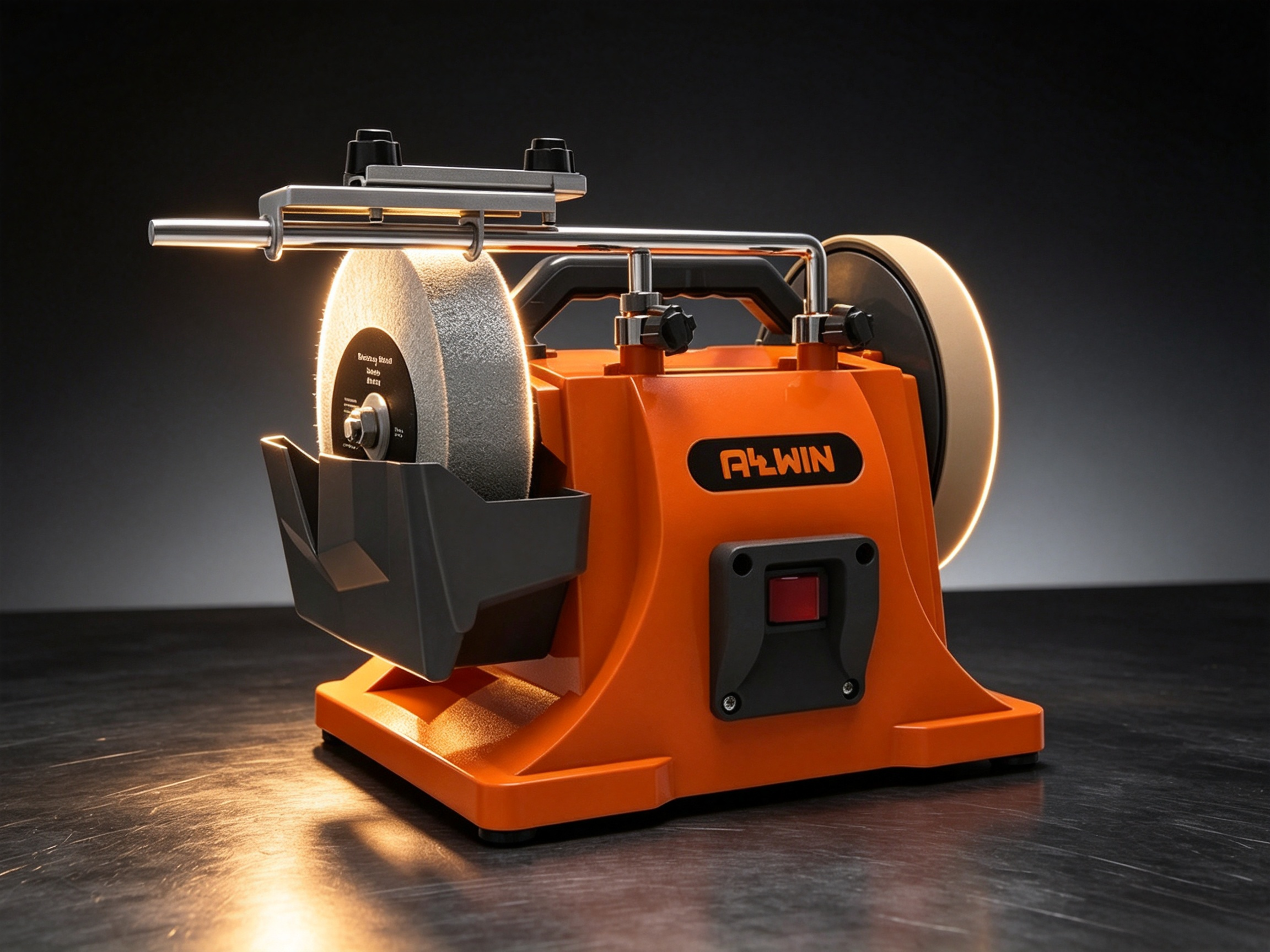
Many users who have been using desktop knife sharpeners for a long time can only simply turn it on for grinding, but do not understand the basic structure and core principles of the equipment. They are unable to start when they encounter slight equipment abnormalities, accuracy deviations, and working conditions adaptation problems. If you want to use a desktop knife sharpener proficiently, safely and efficiently, and at the same time do equipment debugging, basic maintenance and matching working conditions, the first prerequisite is to have a thorough understanding of the basic structure, operating principles and core parameter logic of the equipment. This article is general dry information, suitable for all desktop knife sharpening machine models. There are no restrictions on scenarios or tools, and it is suitable for all practitioners to get started.
一. Core basic structure of desktop knife sharpening machine
The overall structure of the desktop knife sharpening machine is highly modular, and the core components of all models are consistent. It is mainly divided into five modules: the main body of the machine, the power drive system, the grinding execution system, the adjustment and calibration system, and the protective auxiliary system. Each module performs its own duties and jointly determines the stability of the equipment operation and the grinding effect.
- The main body of the rack is the load-bearing foundation of the equipment. It is mostly made of heavy cast iron, which is highly rigid and not easily deformed. It can effectively offset the vibration generated during the grinding process and is the core basis for ensuring grinding accuracy. Thin and light frames are prone to problems such as jitter, uneven polishing textures, and accuracy deviations, which are also one of the core differences between high-end and low-end models.
- The power drive system consists of motors, transmission components, and rotating shafts, and is the power source of the equipment. High-quality desktop knife sharpeners mostly use pure copper motors, which have stable power output, low temperature rise, and strong durability. The transmission structure is compact and has no slack, which can ensure a constant speed and avoid problems such as rapid and slow speed during the grinding process, resulting in edge burns and uneven grinding.
- The core of the grinding execution system is consumable accessories such as grinding wheels and grinding discs, which are the core components that directly complete the grinding operation. The material, grain size, hardness, and balance of the grinding wheel directly determine the grinding efficiency, finished product roughness, and edge quality. They are also the core focus of subsequent equipment debugging and consumable replacement.
- The adjustment and calibration system includes an angle adjustment bracket, a fine-tuning knob, a limit device, and a horizontal calibration structure. It is used to adapt to different grinding needs and accurately control the grinding angle, feed amount, and grinding stroke. It is a key structure to achieve standardized grinding and eliminate manual errors.
- The protective auxiliary system covers protective covers, dust-proof devices, shock-absorbing foot pads, and switch control systems. Its main function is to ensure operational safety, reduce dust pollution, reduce equipment operating vibration, and at the same time improve the convenience and safety of equipment use.
二. General working principle
- The core working principle of the desktop knife sharpening machine is the principle of high-speed rotational grinding. The motor drives the grinding wheel to run at a constant speed through the transmission structure. The abrasive grains on the surface of the grinding wheel are used to uniformly grind the metal layer of the tool edge, remove the worn, passivated, and broken surface metal of the tool, and reshape the shape of the edge into a smooth, sharp, and standard shape.
- Different from the randomness of manual grinding, the desktop knife sharpener relies on mechanical fixation and uniform rotation to ensure the uniformity of grinding strength, angle, and speed. It can fundamentally avoid problems such as manual grinding angle deviation, edge concave and convex, and uneven force, and is suitable for normalized and standardized grinding operations.
三. General interpretation of core parameters
The core general parameters of all desktop knife sharpeners are the same. By reading the parameters, you can judge the equipment performance, adaptable working conditions and upper limit of use, without distinguishing between models.
- Rated power determines the power strength and load capacity of the equipment. The higher the power, the more sufficient the power reserve. When grinding carbide, thick blades, and large areas, it is less likely to jam, machine boring, or overload heating. It is suitable for high-frequency, high-intensity operations; low-power equipment is only suitable for light, daily fine grinding.
- No-load speed and rated speed, speed stability is better than speed value. A constant rotational speed can ensure uniform grinding texture and no burn on the cutting edge. Equipment with large rotational speed fluctuations is prone to uneven grinding quality. At the same time, different rotational speeds are suitable for different grinding processes. High rotational speeds are suitable for fine grinding and polishing, while low rotational speeds are suitable for rough grinding to remove passivation and repair chipping.
- Grinding wheel specifications, including diameter, thickness, hole diameter, and particle size. The size of the grinding wheel determines the grinding stroke and the size of the adapted workpiece, and the particle size determines the grinding accuracy. The coarse particle size is suitable for quick grinding and wear removal, and the fine particle size is suitable for fine grinding, polishing, and improving edge flatness.
- Adjustment accuracy represents the fine-tuning ability of the equipment. The smaller the value, the higher the accuracy. It can meet the needs of fine grinding and high-precision tool repair. It is a key parameter that distinguishes ordinary models from precision models.
- The self-weight of the whole machine. The greater the self-weight, the better the stability of the frame, the stronger the shock absorption effect, the smaller the jitter during the polishing process, and the higher the accuracy and consistency of the finished product.
四. Universal matching logic of parameters and working conditions
For light daily maintenance grinding and fine grinding, small and medium power, high speed, and fine-grained grinding wheel configurations can be selected; for high-frequency batch grinding, hard tool grinding, and large-area repairs, high-power, high stability, coarse and medium-grained grinding wheel configurations must be selected to ensure operating efficiency and equipment stability. Understanding the structure and parameters is the core foundation for subsequent operations, maintenance, and troubleshooting.
Post time: Aug-20-2026