


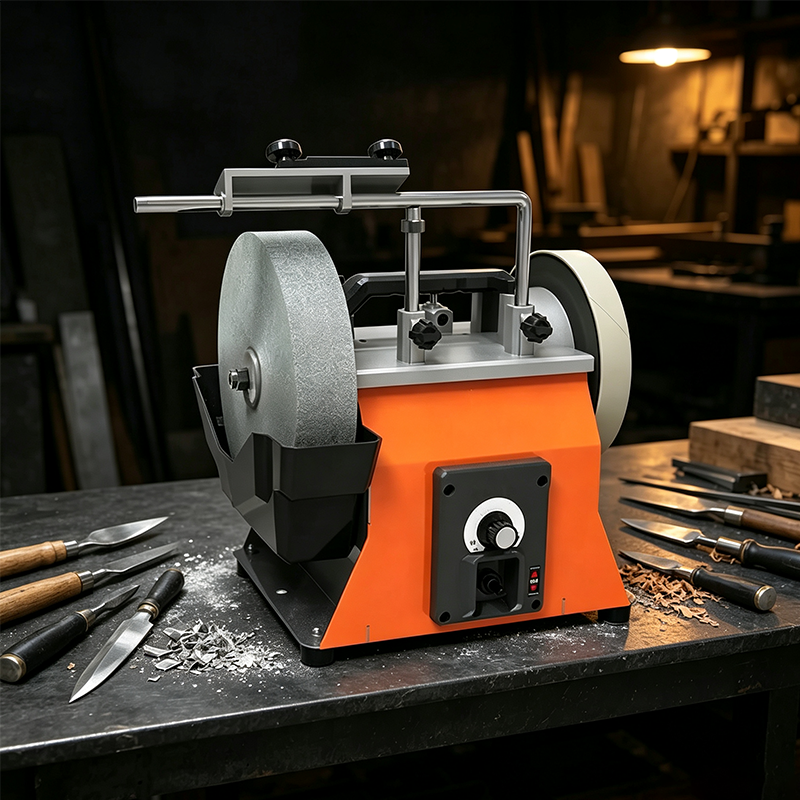
Desktop knife sharpeners are the core equipment for small-scale precision grinding. The mainstream models on the market are divided into two main models: desktop regular models and handheld models. They are suitable for different operating needs and widely cover household repairs, outdoor DIY, carpentry, farm operations, catering kitchens, hardware repairs and other scenarios. The core of selection is to fit the usage scenario, understand the core parameters, strictly abide by the purchase standards, and at the same time master the correct usage skills to avoid equipment and tool wear problems.
一. Regular model VS handheld model: selection
1. Regular model: Recommended for hard-core work and batch grinding
- The regular model is the “heavy-duty main model” among knife sharpening equipment, and is suitable for high-frequency and large tool grinding scenarios such as farmers, handicraft workshops, and hardware repairs.
- The power of the models is generally between 150-500W, and the power reserve is sufficient. It can easily grind large-sized and high-hardness tools such as axes, sickles, scissors, woodworking planes, and chisels. It has strong load-bearing capacity and will not easily get boring.
- The diameter of the grinding wheel is 150–250mm, the grinding coverage is large, and the operating efficiency is far higher than that of the handheld model. One grinding knife can complete the workload of multiple operations of the handheld model.
- With a cast iron base, it has sufficient weight, good shock absorption, and stable operation without jitter. After grinding, the blade surface of the tool is smooth and smooth, with higher precision. It is fully suitable for long-term continuous batch operations.
2. Handheld model: finely polished, exclusive for outdoor portability
- The handheld model focuses on lightweight and high precision, and is suitable for outdoor operations, DIY experts, and fine tool grinding scenarios.
- The whole machine weighs less than 3kg. It is light and portable, can be operated by hand, and can be carried out at any time. It is suitable for the maintenance of outdoor knives and small precision tools.
- The equipment speed can reach 20,000–30,000 rpm. The high speed is suitable for fine grinding. It can grind small precision tools such as engraving knives, fish hooks, and utility knives, and easily grind out a uniform and sharp edge.
- The standard 15°–30° adjustable angle bracket provides controllable angles and low error tolerance, enabling standardized edge cutting to meet fine grinding needs.
二. Three golden rules for purchasing (core to avoid pitfalls)
1. Match the model according to the scene: for batch grinding of large-sized tools in farms and workshops, priority is given to regular models that are stable and efficient; for outdoor portable use, and for DIY fine grinding of small precision tools, lightweight and flexible handheld models are selected. Selection on demand can avoid excessive performance or insufficient power.
2. Strictly match consumable grinding wheels: The suitability of consumables directly determines the grinding effect. Choosing the wrong consumables is futile. Diamond grinding wheels are suitable for carbide tools, and aluminum oxide grinding wheels are suitable for high-speed steel and carbon steel tools. At the same time, priority is given to models with replaceable grinding wheels to reduce long-term use costs.
3. Adhere to the basics and solid design: all protective configurations are indispensable. The standard protective cover can effectively block sparks and avoid the risk of burns; the independent emergency stop switch can cut off the power in one second in case of emergencies, preventing accidents; models with anti-accidental locking design can effectively avoid misoperation and make use more secure.
三. Advanced usage skills to improve polishing texture and equipment life
1. Water cooling to prevent annealing: High temperature is the core cause of tool scrapping. Continuous dry grinding will lead to edge annealing, loss of hardness, and easy edge curling in the later period. In actual operation, the principle of “grinding and soaking in water for 30 seconds to cool down” is followed to quickly dissipate heat and retain the original hardness and toughness of the tool.
2. Regularly dress the grinding wheel: Grinding wheels that have been used for a long time are prone to clogging and deformation, resulting in reduced grinding efficiency and uneven blade surfaces. Regularly cleaning and repairing the grinding wheel with a diamond dresser can keep the grinding wheel flat and sharp and greatly improve the grinding efficiency.
3. Clamp fixation control accuracy: Manual grinding is prone to angle deviations. Be sure to use a special clamp to fix the tool. The grinding error can be controlled within 1° to ensure symmetry of the cutting edge and uniform sharpness.
4. Shock absorption and noise reduction equipment: Vibration of the machine body not only produces noise, but also affects grinding accuracy and accelerates bearing wear. Installing a rubber pad at the bottom of the base can effectively reduce vibration and noise. According to actual measurements, it can reduce the noise by 15 decibels, taking into account both the user experience and the life of the device.
四. Summary of model selection
There is no need to blindly pursue high-end configurations when selecting a desktop knife sharpener, the core is scene adaptation. For high-frequency commercial use and large tool grinding, choose the cast iron base and high-power regular model; for outdoor portability and fine grinding, choose the high-speed, fine-adjustable handheld model. At the same time, following the principle of matching consumables and using standardized maintenance and usage techniques can not only avoid purchasing misunderstandings, but also give full play to equipment performance and extend the service life of tools and equipment.
Post time: Jul-16-2026