


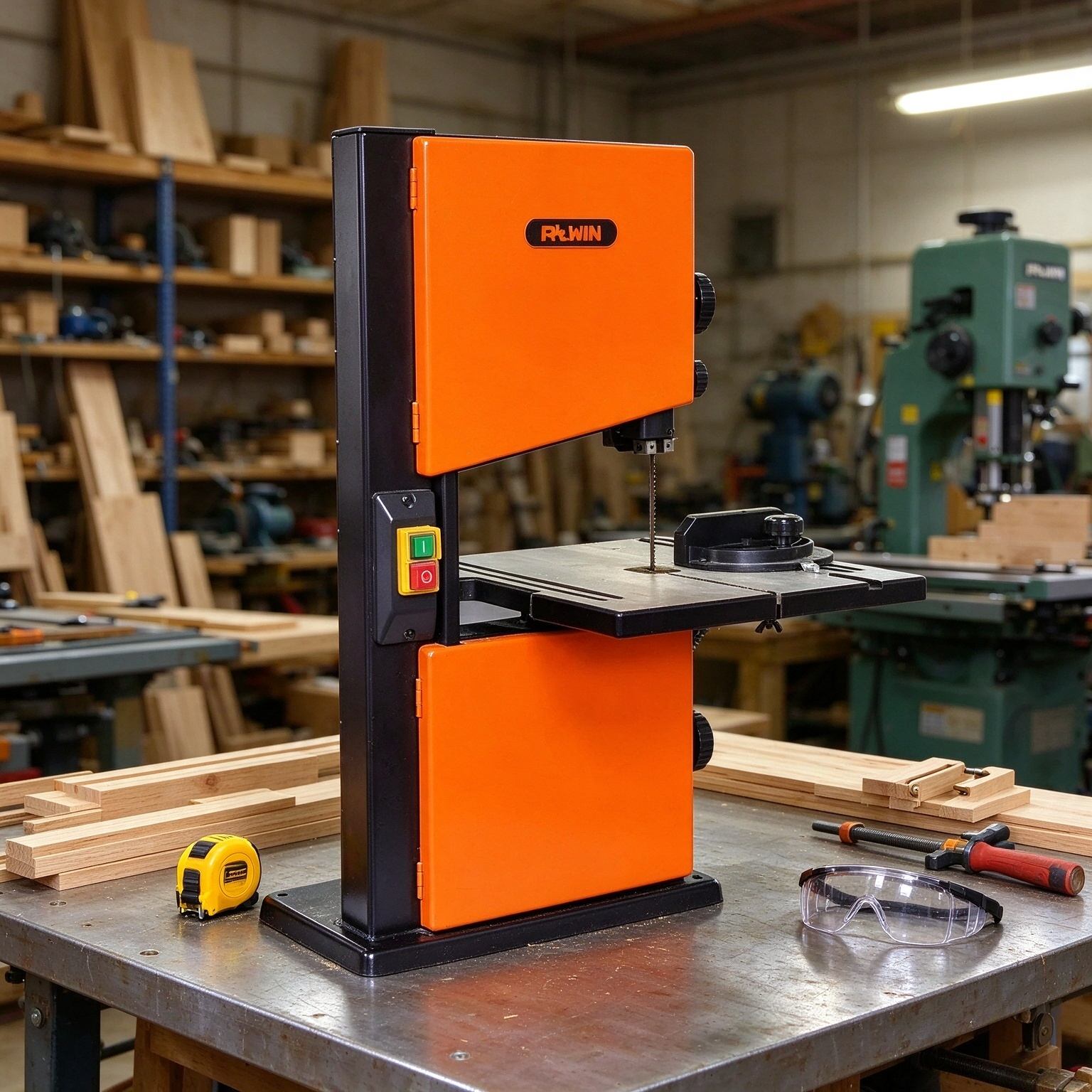
In introductory narratives about woodworking and metalworking, band saws and scroll saws are often compared along the dimension of “cutting straight lines”: band saws cut straight, while scroll saws do not. This statement is not wrong, but it misreads a structural capability boundary as product quality. The reason why the Scroll saws does not go straight is not because of “poor workmanship”, but because its cantilever structure determines that there is no support below the saw blade, and the saw blade will inevitably deflect under the action of the feed force and changes in material texture; even if the upper backer draws the line straight, the lower saw seam will still be crooked, because “up and down synchronization” is not a problem that can be solved by operating skills in a reciprocating mechanism with single-end support. The “straightness” of a band saw depends on another set of conditions that are continuously maintained: the blade tension is correct, the guide block is in the correct position, and the feed matches the thickness of the material. If the tension is insufficient, the saw blade will buckle and wander in the cut; if the tension is too high, the bearings and gear train will accelerate fatigue; if the guide block is worn or deviated, the direction of the drift of the saw blade under load will no longer be controllable.
What these two lines have in common is that “straight line” on these machines is never a factory-locked attribute, but a state that needs to be maintained conditionally in every sawing operation. The precision attenuation of band saws is described very clearly by British equipment manufacturers: Precision rarely collapses overnight. It first manifests as the slope or taper of the cutting surface, saw blade wandering, increased burrs, vibration and noise. These early signals point to saw blade wear, tension deviation, guide misalignment or improper feed control, and the operator often does not realize the problem until the cutting seam is obviously beyond the tolerance. In other words, the “straightness” of a band saw is not a static capability, but a narrow corridor that is continuously maintained between the four variables of tension, guide, saw blade status and feed rate. If any variable drifts out of the window, the slit will be biased, and the direction and magnitude of the bias depend on which variable falls first.
Putting these two machines in the same “accuracy” framework will lead to a more useful judgment than “who is straighter”: they serve two different error acceptance structures. The structural deflection of the Scroll saws is known and the direction is predictable (it always deflects to the side with the weaker force), so it is suitable for those processes where there is room for trimming later, or where the curve itself does not require strict tolerances. The band saw’s error is conditional and manageable. When the tension, guide and feed are correctly maintained, it can stably cut straight lines; once the conditions are lost, it tends to be “quieter” than the Scroll saws because the operator cannot easily read the buckling of the saw blade inside the cut from the feel and sound. The most common mistake in bench tool selection is not to choose the one with “lower accuracy”, but to regard the conditional accuracy of a machine as the inherent accuracy, and then attribute the deflection to “the machine is not good” when the conditions are no longer maintained, rather than to the condition corridor that should be continuously watched.
Post time: Oct-29-2026