


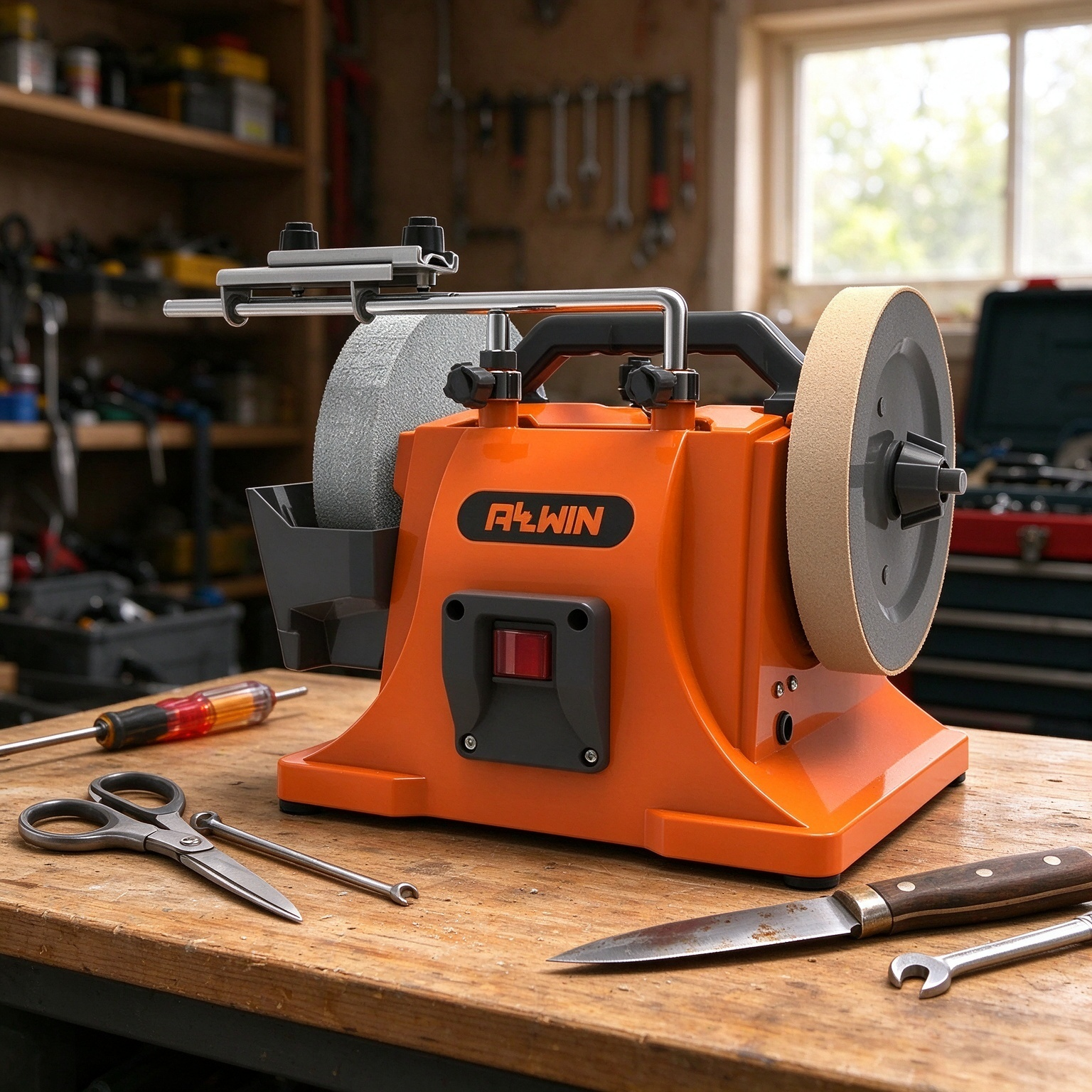
Knife sharpening machines are classified as “auxiliary equipment” on the accounts of most factories. This accounting classification itself is the most profound misunderstanding of its value. What the knife sharpener deals with is never “a dull knife”, but an asset curve that is accelerating depreciation. Its function is to select the correct cutoff point on this curve and bring things that have been judged as “waste” back into the production function.
The cost structure of carbide cutting tools determines the weight of this matter. In 2025, cemented carbide prices will hit a multi-year high, with an overall increase of about 150%, and some markets have a year-on-year increase of as much as 210%. In this raw material price environment, if a tool is thrown into the scrap bin prematurely, the loss is no longer the purchase price of tens of dollars, but a piece of tungsten and cobalt that could continue to generate cutting value. The industry benchmark given by ANCA is: high-quality carbide tools can usually be regrinded three times, and the cost of a single regrinding is only 30%-40% of a new tool. A single tool can save up to 70% of the cost during the entire life cycle. This means that every time the knife sharpener correctly performs regrinding, it actually locks in a certain cost advantage for the company in the storm of raw material price fluctuations.
But knife sharpeners go far beyond just “saving money.” Research published by a team from Nanjing University of Aeronautics and Astronautics in the Journal of Mechanical Engineering revealed a more fundamental problem: the traditional regrinding process requires an average of 15% of the healthy metal of the tool to be ground away. The repair loss is too large, causing a large number of tools to end their economic life prematurely during the process of being “repaired”. The dynamic topology compensation algorithm developed by the team uses μ-level industrial CT scanning to identify worn areas and uses an improved ant colony algorithm to plan the minimum material removal path, reducing the repair loss rate to 3.8%. The significance of this number needs to be understood on an industrial scale: my country produces 450,000 tons of discarded tools every year, 32% of which are economically unbalanced due to excessive repair losses. When the repair loss rate drops from 15% to 3.8%, the knife sharpener changes from a “machine that makes the knife faster” to a “machine that determines how much tungsten resources need to be dug out of the ground again.”
This is the true dimension in which knife sharpeners are underrated. In the cost narrative of manufacturing, procurement is explicit, downtime is explicit, and “the portion of tool life that is not used up” is implicit. The value of the knife sharpener lies precisely in the fact that it manages this hidden account. A five-axis CNC knife sharpening machine allows the grinding accuracy to be controlled within 0.005mm. The reground tool is fully sufficient for rough machining and semi-finishing. The factory’s approach has changed accordingly: new knives do fine work, and regrinding knives does rough work. Each knife is matched to different processes at different stages of its life cycle. Tools no longer have a unified “disposal moment”, but a carefully managed “degradation path”. The knife sharpener is therefore not an auxiliary device, it is a management terminal for tool assets.
Post time: Oct-29-2026