


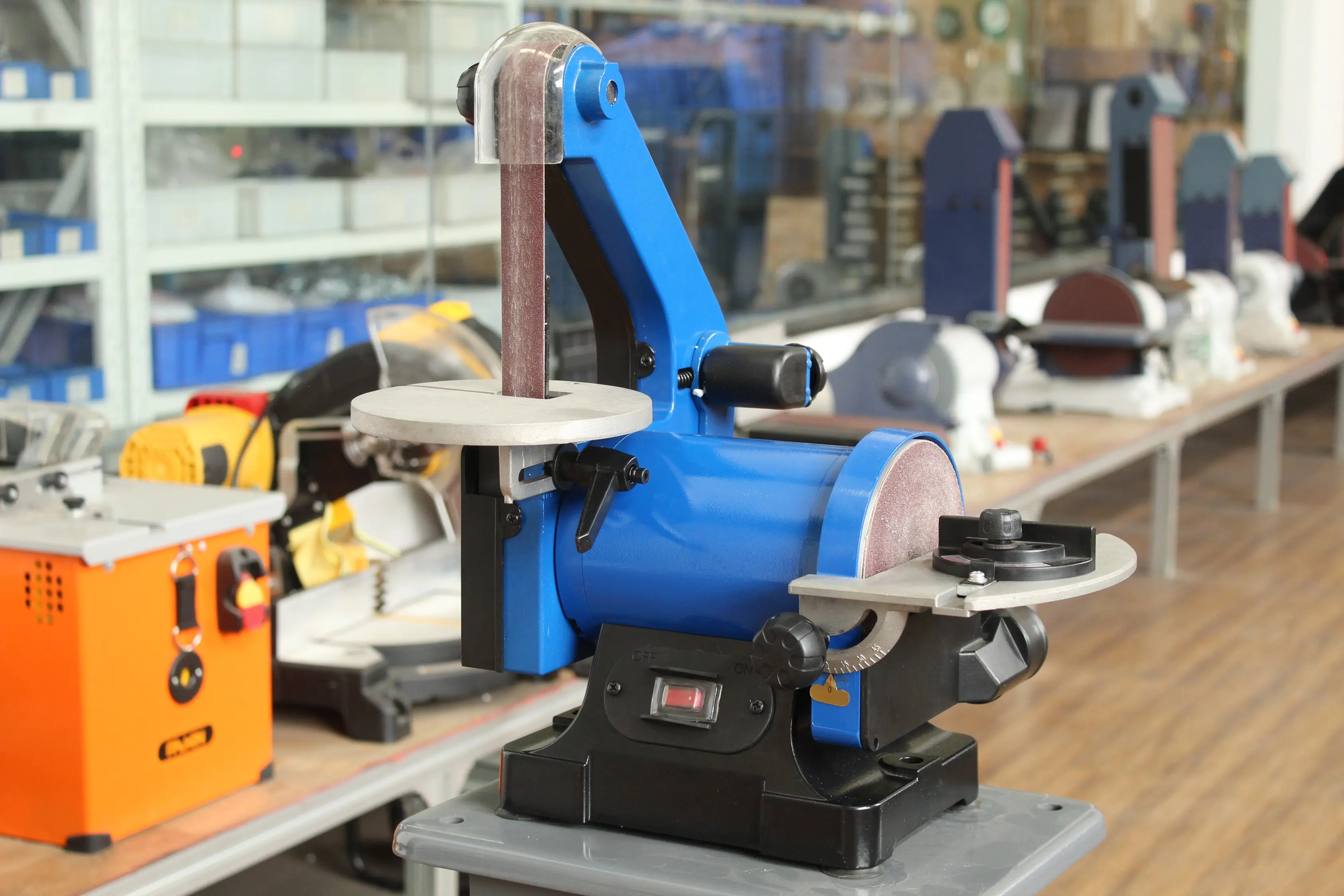
Abrasive belts used in belt sanders belong to the category of coated abrasives and are among the most widely used consumables for grinding, sanding, and polishing applications. With continuous advancements in abrasive materials and manufacturing technologies, sanding belts are now widely used across various applications, including woodworking, metalworking, fabrication, and industrial finishing.
Understanding how to select the correct abrasive belt grit size is crucial for achieving the desired surface finish while maintaining high productivity and extended belt life.
What Is a Sanding Belt?
Sanding belts are manufactured by bonding abrasive grains of different grit sizes onto a backing material—typically cloth, paper, or polyester—using a resin-based bonding agent. The coated material is then cut to size, joined end-to-end to form a continuous loop, and mounted on a belt sander. When driven by the machine, the belt rotates at high speed, allowing it to perform material removal, surface leveling, deburring, or polishing operations.
Common Abrasive Belt Grit Sizes
| Grit Size Range | Abrasive Type | Typical Application |
| 24 – 40 | Very Coarse | Heavy stock removal, weld grinding, paint stripping |
| 50 – 60 | Coarse | Shaping, flattening surfaces, removing saw marks |
| 80 – 120 | Medium | General sanding and smoothing |
| 150 – 180 | Medium-Fine | Surface preparation before finishing |
| 240 – 320 | Fine | Light finishing and surface refinement |
| 400 and above | Very Fine | Polishing and precision finishing |
Recommended Grit Selection by Application
| Application | Recommended Grit Size |
| Weld scar grinding / casting riser removal | 36 – 40 |
| Deburring and burr removal | 60 – 120 |
| Coarse grinding | 80 – 120 |
| Fine grinding | 150 – 240 |
| Polishing | 320 and above |
Relationship Between Grit Size and Surface Roughness
| Abrasive Grit Size | Processing Step | Surface Roughness (Ra) |
| P16 – P24 | Rough Grinding | - |
| P30 – P50 | Coarse Grinding | Ra 6.3 – Ra 3.2 |
| P60 – P120 | Semi-finish Grinding | Ra 3.2 – Ra 0.8 |
| P150 – P240 | Fine Grinding | Ra 0.8 – Ra 0.2 |
| P320 – P1200 | Ultra-precision Grinding | Ra ≤ 0.2 |
| P1500 and finer | Polishing | Ra ≤ 0.05 |
Best Practice for Grit Selection
Where surface roughness requirements are met, selecting the coarsest possible grit ensures higher grinding efficiency, reduced processing time, lower abrasive consumption, and improved overall productivity. Fine grits should be used only during the final finishing or polishing stages.
Post time: Dec-22-2025