


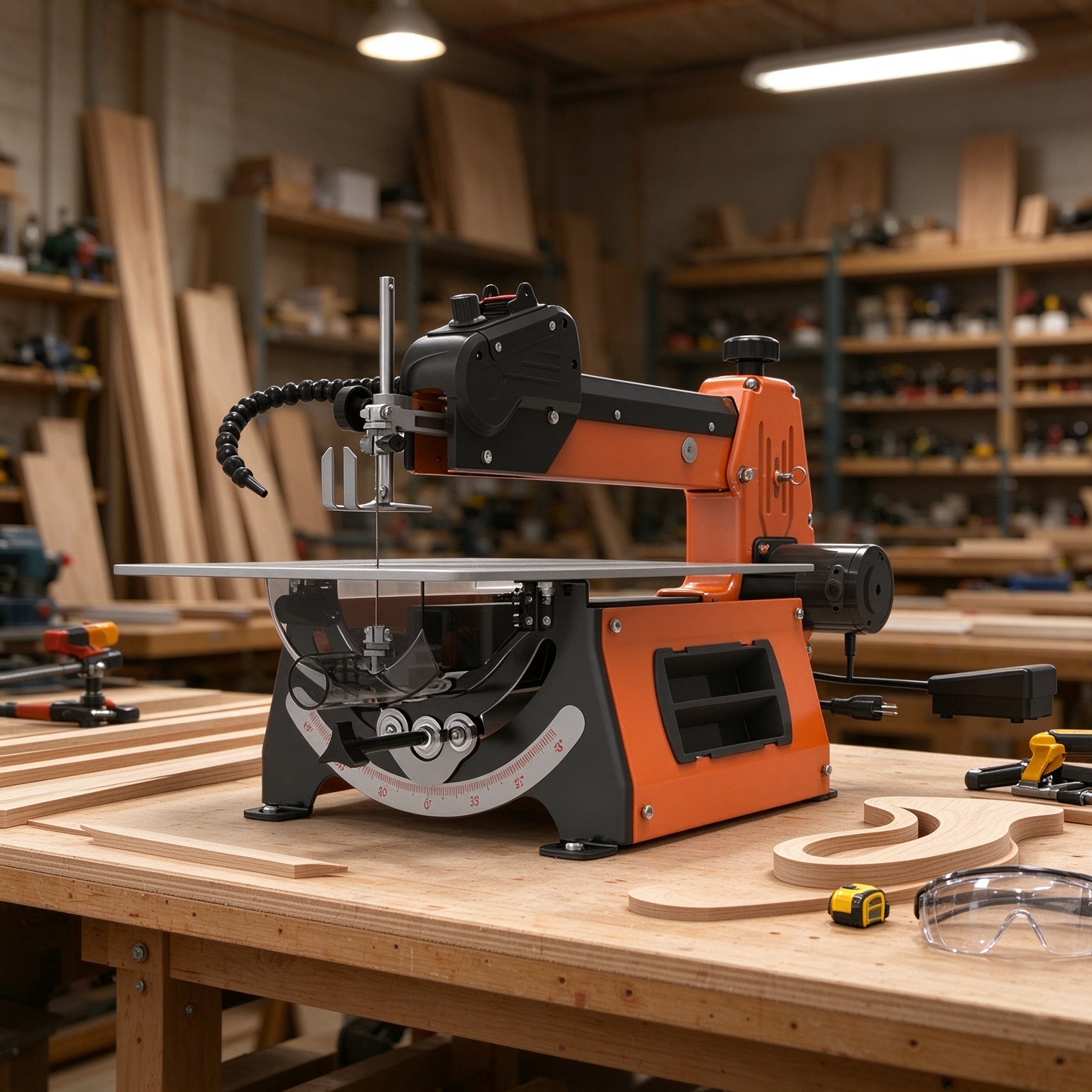
The scroll saw does not cut straight, and has long been classified under the “tool positioning” explanation framework in industry discourse: it is a shaping tool, and straight lines are not its strong point. This framework is partly right, but it obscures a more specific matter. The real trouble that users encounter is often not that the cutting path deviates on the plane – plane deviation can be restricted by the backing and line of sight – but that the top and bottom of the cut surface are not vertical. The saw blade is a thin steel piece, with the lower end suspended in the air for reciprocating motion. When the thick plate is pushed up, the saw blade buckles inside the cut, and the cut surface is an inclined plane. This bevel cannot be eliminated by operating techniques because its origin lies in the support structure of the saw blade: one end is fixed and the lower end is free.
But “structural determination” does not mean “impossible to improve.” The verticality of a scroll saw is precisely a dimension of precision that can be systematically achieved through design, and a clear engineering path has emerged in the industry. The most direct idea is to add a lower guide constraint on the bottom plate: let the saw blade also receive lateral support during the stroke below the workpiece, turning the “single-end cantilever” into a “two-end constraint”. The solution recorded in the patent document includes setting up a guide device under the bottom plate, using guide blocks and guide rails to constrain the lateral swing of the saw blade, so that the cutting direction is mechanically limited to a vertical plane. Another idea is to make the abutment surface strictly perpendicular to the saw blade: the abutment surface supporting the workbench is designed to be perpendicular to the guide groove. When the workpiece is fed along the abutment surface, the cutting direction and the saw blade plane are maintained at 90 degrees. The perpendicularity is locked by geometric relationships rather than maintained by the operator’s wrist.
A detail that has been discussed repeatedly, but is rarely taken seriously in production, is the angle between the saw bar and the base plate in the “zero knife lift” state. The original intention of the knife lifting function is to allow the saw blade to avoid the workpiece during the return stroke, reducing friction and heat. However, part of the design is implemented by causing the saw bar to deviate from the 90-degree relationship with the base plate when the knife is not raised. Only by pushing the knife lift position to the maximum can the saw bar be “straightened” to the vertical position. This turns the verticality into a variable coupled with the functional gear: if the user does not need to lift the knife, he will lose the verticality at the same time; if he pursues verticality, he will have to accept the extra action brought by lifting the knife. A more reasonable engineering design is to make the vertical state the default state when the tool is lifted at zero, and the tool lift only superimposes a controlled offset when needed, instead of making the offset the norm and the vertical a special case.
The verticality issue of the scroll saw therefore does not stop at the level of “user technique” or “tool quality”. It points to a clear design responsibility: when the cantilever structure of the saw blade determines that verticality does not occur automatically, you can choose to encode it into the structure of the machine with lower guides, abutment surface geometry, and zero angle design. A bottom plate with guide grooves, an adjustable lower guide block, and an assembly reference that uses 90 degrees as the default rather than as an option – but what it changes is the accuracy of the curve: the verticality changes from “a deviation that requires continuous compensation by the operator” to “a state that is locked at the factory.” The real space for the precision competition of scroll saws is to change the verticality solutions that have been verified by patents and forum discussions from “optional modifications” to “standard configurations”.
Post time: Oct-29-2026