


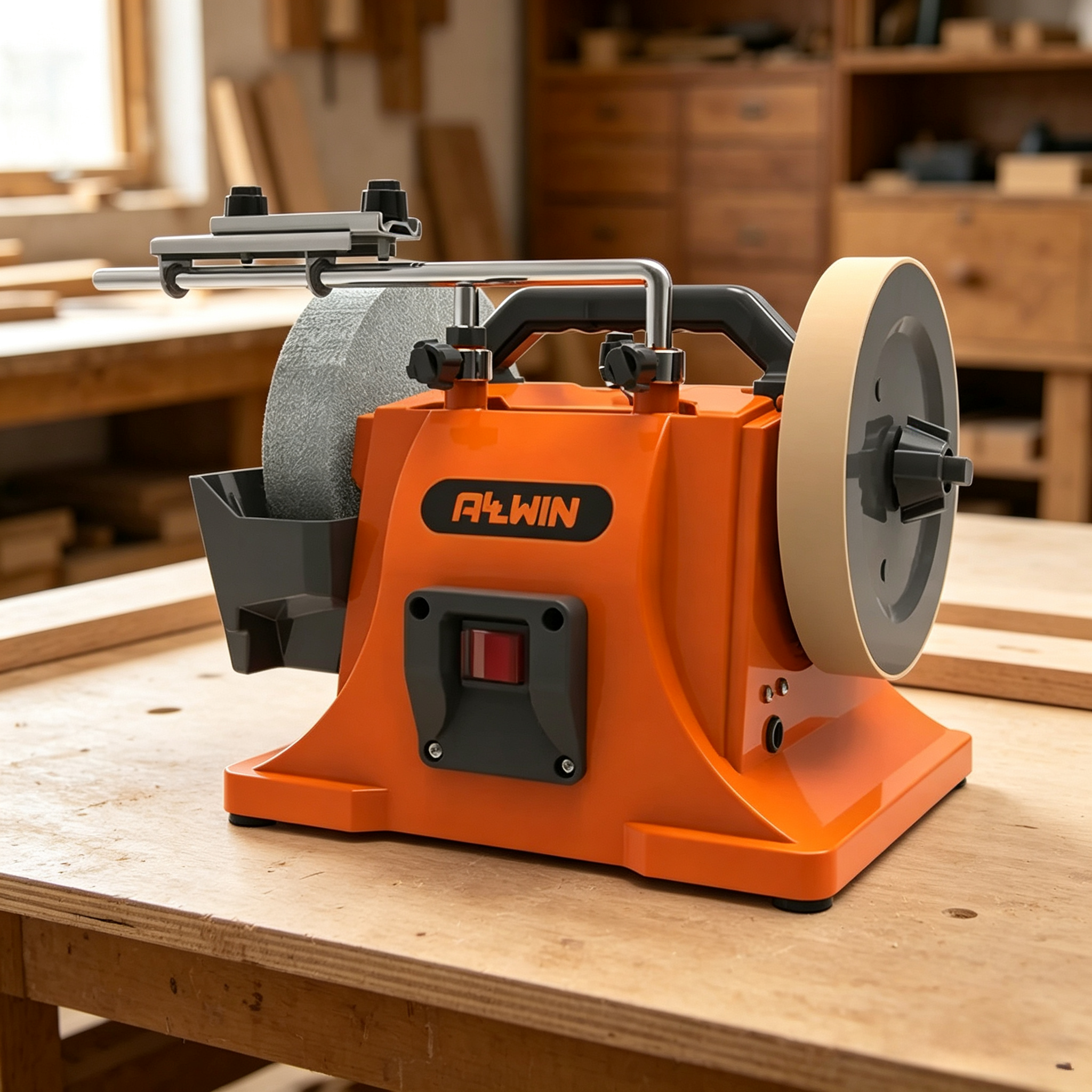
The service life, operational stability, and grinding accuracy of a desktop knife sharpener depend entirely on daily maintenance and periodic maintenance. The premature aging, accuracy loss, and frequent breakdown of most equipment are not due to equipment quality problems, but are caused by lack of maintenance and irregular maintenance. This article organizes a complete maintenance system regardless of machine model or scenario. It is divided into three major parts: daily maintenance, periodic maintenance, and long-term storage and maintenance. It can extend the life of the equipment, stabilize accuracy, and reduce failures at a low cost.
一、Daily general maintenance
1. The core of daily maintenance is cleaning, cooling, and basic inspection, which is the simplest and most effective way to extend life. Before daily operation, clean the dust and metal debris on the workbench, grinding wheel surface, and adjustment track to avoid hard debris remaining, which may cause grinding scratches, track jamming, and accessory wear. Check the surface condition of the grinding wheel and clean the attached metal chips to ensure normal grinding performance of the grinding wheel.
2. After daily operation, thoroughly clean the dust from the entire machine, focusing on cleaning the motor heat dissipation vents, transmission gaps, adjustment rails, and dust-proof components. Dust accumulation will block heat dissipation, accelerate the wear of accessories, and affect the flexibility of the equipment. After cleaning, keep the equipment dry and clean, check the status of power cords, switches, and fasteners to make sure they are not loose or damaged.
3. Simply observe the operating status of the equipment every day, and record minor problems such as abnormal noise, vibration, abnormal speed, etc., so as to detect and deal with them early to avoid small problems from accumulating into major faults.
二、Periodic standardized maintenance (weekly + monthly + quarterly)
1. The focus of weekly maintenance is tightening and fine-tuning. Comprehensively inspect all fixing screws, locking knobs, and bracket connectors of the entire machine. Tighten loose parts one by one to eliminate running lag and avoid increased vibration and accuracy deviation. Check the tightening status and balance of the grinding wheel, and correct minor deviations in time.
2. Monthly maintenance focuses on lubrication and loss inspection. Appropriate lubrication should be performed on the equipment’s adjustment track, fine-tuning shaft, and movable transmission parts to ensure smooth adjustment, no jamming, and no dryness. Excessive oiling is prohibited to avoid adsorbing dust and forming sludge to wear parts. Comprehensively check the wear degree of wearing parts, including grinding wheels, protective rubber pads, shock-absorbing foot pads, and switch components. If the wear exceeds the standard, replace them in time.
3. Quarterly maintenance is in-depth maintenance, focusing on calibrating equipment accuracy, recalibrating the level of the entire machine, grinding wheel concentricity, and adjustment benchmarks, and correcting minor accuracy deviations caused by long-term use. Clean the accumulated dust inside the motor, check the temperature rise and operating noise of the motor, check the aging of circuit lines, and replace aging and damaged lines in a timely manner. At the same time, check the rust-proof status of the entire machine and perform rust-proof treatment on exposed metal parts.
三、General maintenance and replacement logic for wearing parts
Common wearing parts for desktop knife sharpeners include grinding wheels, shock-absorbing foot pads, protective accessories, small transmission parts, and switch components. There is no need to distinguish between models. The grinding wheel is a high-frequency loss part. It must be replaced in time when uneven wear, surface passivation, cracking, chipping, or eccentric shaking occurs. It is prohibited to use it when it is sick. Aging, hardening and collapse of the shock-absorbing foot pads will cause the equipment to increase vibration and reduce accuracy. Please replace them in time after aging. All wearing parts follow the general principle of “regular inspection, replacement as needed, and no compromise”.
四、Long-term shutdown, storage and maintenance specifications
If the equipment is out of service for a long time (more than 7 days), it needs professional storage and maintenance. Thoroughly clean the dust and metal debris from the entire machine and dry it to avoid metal corrosion and circuit dampness caused by humid environment. Apply a thin layer of anti-rust oil to the exposed metal and adjusting parts of the fuselage to isolate air moisture. Disassemble the grinding wheel and store it separately to avoid long-term pressure deformation and moisture deterioration. The equipment should be placed in a dry, ventilated, and flat environment and covered with a dust cover to avoid dust accumulation, exposure to the sun, and moisture. Before restarting use, it needs to be fully recalibrated and tested without load, and then put into operation after confirming that it is normal.
五、Core principles of general maintenance
Maintenance does not require complicated operations. The core is “clean frequently, tighten frequently, lubricate accurately, replace early, and store stably.” Adhering to standardized periodic maintenance can reduce the equipment failure rate by more than 80%, while stabilizing the grinding accuracy of the equipment in the long term and greatly extending the service life of the entire machine.
Post time: Sep-02-2026