


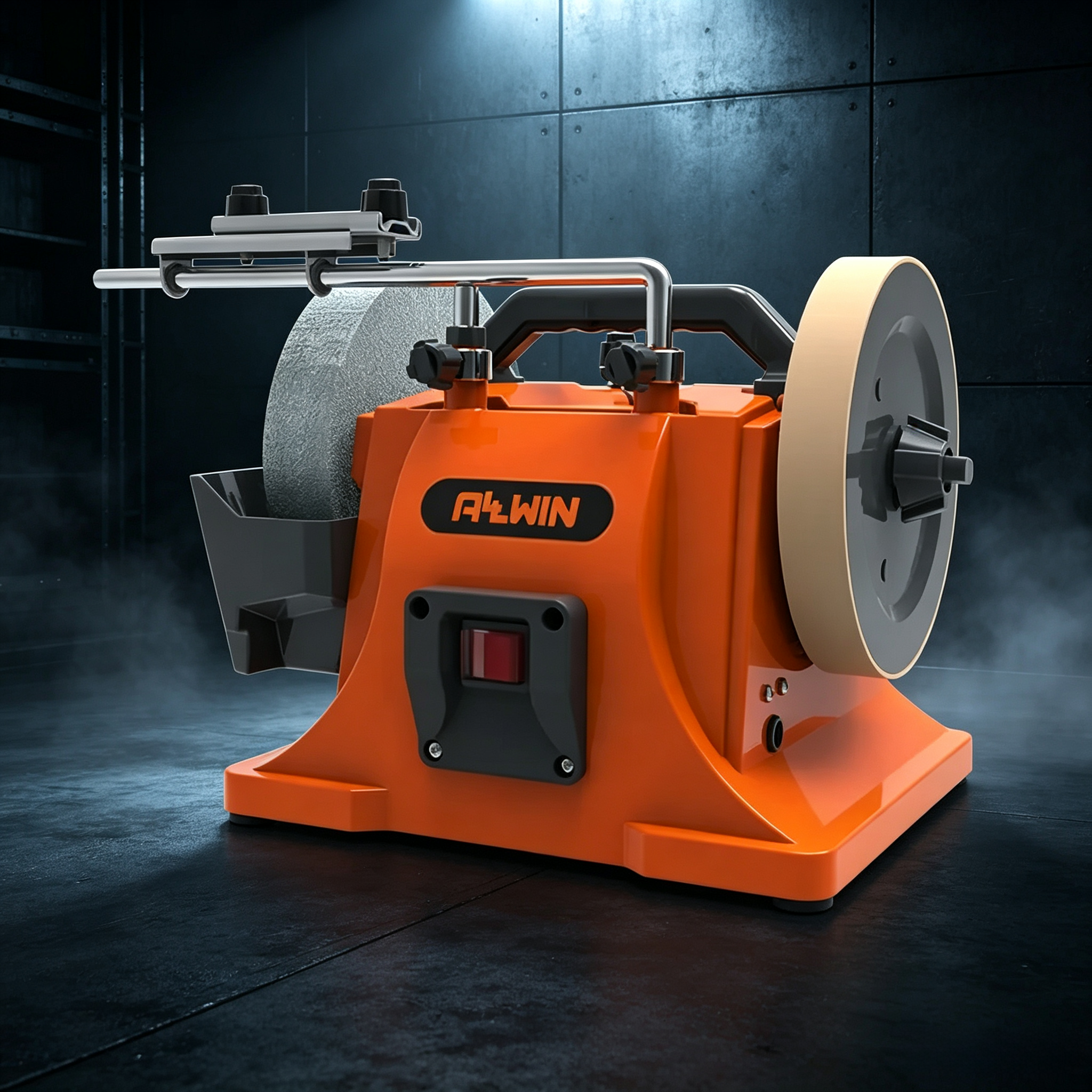
The grinding accuracy, operating efficiency, finished product quality and equipment service life of a desktop knife sharpener mainly depend on whether the consumables are adapted to standards. The problems encountered by most users such as edge burns, uneven grinding lines, equipment vibration, and accuracy deviation are not caused by operation or equipment faults, but caused by incorrect selection of consumables, improper adaptation, and overdue service. Consumables are the core grinding carrier of a knife sharpening machine. Mastering the selection logic, working condition adaptation standards and loss replacement specifications is the core basis for standardized grinding operations.
The core general consumables of desktop knife sharpening machines are grinding wheels as the core, along with auxiliary accessories such as gaskets and shock-absorbing pads. Among them, the four parameters of the grinding wheel, including material, particle size, hardness, and specifications, determine more than 90% of the grinding effect. Model selection needs to follow the three core principles of matching working conditions, complementary materials, and parameter adaptation, and can be adapted to basically a variety of desktop knife sharpening machines.
From the perspective of core material adaptation, the industry-wide adaptation logic is clear and unified. White corundum grinding wheels are the most versatile and are suitable for grinding all types of carbon steel, tool steel, and ordinary tools. They have low grinding temperature and are not easily burned on the cutting edges. They are the first choice consumables for daily general grinding. It is strictly forbidden to mix thick and fine materials, otherwise there will be problems such as rough grinding marks and inability to fine grind, which will directly reduce the quality of the finished product.
The adaptation of particle size and working conditions is a key universal standard for improving quality and efficiency. Coarse-grained grinding wheels are mainly used for rapid damage removal, chip repair, and tool shaping. They are suitable for batch rough grinding and repair of severely worn tools, focusing on work efficiency. The medium particle size is a universal specification that takes into account both efficiency and precision. It is suitable for daily routine tool grinding, maintenance and polishing, and is suitable for most routine workshop operations. The fine-grained grinding wheel focuses on fine grinding and polishing, used to eliminate grinding lines, remove fine burrs, and improve the flatness and sharpness of the edge. It is only suitable for fine grinding scenarios.
The reverse principle of hardness adaptation, which many users ignore, is the core and in-depth information for consumable selection. The general logic is “soft grinding of hard materials and hard grinding of soft materials”: when grinding high-hardness alloy tools, you need to use a softer grinding wheel to allow the passivated abrasive grains to fall off in time and continue to maintain the grinding sharpness; when grinding ordinary soft steel materials, use a hard grinding wheel to avoid rapid shedding of abrasive grains, extend the service life of consumables, and eliminate ineffective wear.
There is no need to rely on experience to determine consumable loss, just follow general visualization standards. If the surface of the grinding wheel is glazed and passivated, the working surface is uneven, the edges are damaged and cracked, the grinding wheel is running eccentrically, and the rotation speed is normal but the grinding is weak, etc., these are all scrapped standards and must be replaced immediately. At the same time, there is hidden loss of consumables, and long-term use will cause problems such as grinding accuracy attenuation and local high-temperature carbon deposition. Even if the appearance is intact, it is recommended to force replacement after continuous high-intensity operations to avoid hidden effects on grinding quality.
There are general specifications for the installation and replacement of consumables to directly avoid equipment failures and safety hazards. Before replacement, it is necessary to turn off the power and let it stand, and confirm that the equipment has completely stopped; check that the aperture and size of the grinding wheel match the main shaft of the equipment; it is strictly prohibited to force installation if the specifications do not match; after installation, the gaskets should be leveled and evenly tightened, and the grinding wheel balance calibration should be completed to eliminate eccentricity and oversize problems. After replacement, it must be tested without load for 1-2 minutes. After confirming that there is no vibration and no abnormal noise, it can be put into formal operation.
Overall, the core logic of using consumables for desktop knife sharpening machines is not to blindly select high-end consumables, but to rely on precise adaptation based on working conditions, materials, and accuracy requirements, combined with standardized loss determination and replacement processes, which can not only completely solve the problems of grinding defects and equipment abnormalities, but also maximize the service life of consumables and equipment, achieving the triple effects of improving quality, increasing efficiency, and reducing costs.
Post time: Sep-02-2026